

Training · Cyber Defence
Malware Dissection 101
Take real malware apart in a safe lab. Learn file formats, assembly, malicious documents and memory forensics, then turn what you find into detections.
- Beginner
- 40 hours
- 5 days
- 5-day bootcamp
About the course
Every incident eventually leads to a suspicious file. Knowing what it does, how it got in and what it left behind turns an alert into a confident response.
This bootcamp introduces reverse engineering and malware analysis to defenders with no prior experience in either. Every topic is practised hands-on in an isolated lab with industry-standard tools, and the week ends with a team capstone on an unknown sample.
Who should attend
- SOC analysts who triage suspicious files
- Incident responders and DFIR practitioners
- Threat intelligence analysts
- IT security staff handling phishing and endpoint alerts
- Students and developers starting out in security
What the course covers
Six topics in focus
01
Malware and file formats
Malware types, PE and ELF structure, packers and metadata.
02
Assembly and program structure
Reading x86 and x64 code, registers, flags and the stack.
03
Behavioural analysis
Watching what a sample does to files, registry and network.
04
Malicious documents
PDF, RTF and Office files that deliver malware.
05
Unpacking and injection
Packed samples, code injection, API hooking and anti-debugging.
06
Memory and reporting
Memory forensics, YARA rules, IOCs and analysis reports.
Tools and technologies
- Ghidra
- x64dbg
- PE-bear
- Procmon
- Wireshark
- Volatility 3
- YARA
Course outline
5 days, one capstone
- Day 1 Introduction to reverse engineering Malware types, analysis approaches, file formats and packers.
- Day 2 Reverse engineering fundamentals Building a safe analysis lab and reading core assembly.
- Day 3 Behavioural and document analysis Running samples, recording what they do, and taking apart malicious documents.
- Day 4 Advanced techniques Unpacking, code injection, anti-debugging and memory forensics.
- Day 5 From analysis to detection YARA rules, IOCs, case studies, and the capstone.
Capstone
Unknown sample
Teams take an unknown sample from triage to a YARA rule, an IOC list and a short presentation of findings.
Outcomes
You will be able to
- Build and use a safe malware analysis lab
- Triage PE and ELF files and spot packers
- Read basic x86 and x64 assembly in Ghidra
- Analyse malicious documents and executables
- Write YARA rules and a clear analysis report
Before you join
Prerequisites
- Cyber Security 102 or equivalent hands-on basics
- No prior reverse engineering or assembly needed
- Basic networking (TCP/IP, DNS and HTTP)
- Some Python or C helps
Learning path

Take before
Cyber Security 102
Turn the basics into hands-on skills. Scan networks, test web apps and harden systems in a safe lab, then switch sides to detect and respond.
Beginner+ · 30 hours · 5 weeks · Live online
View course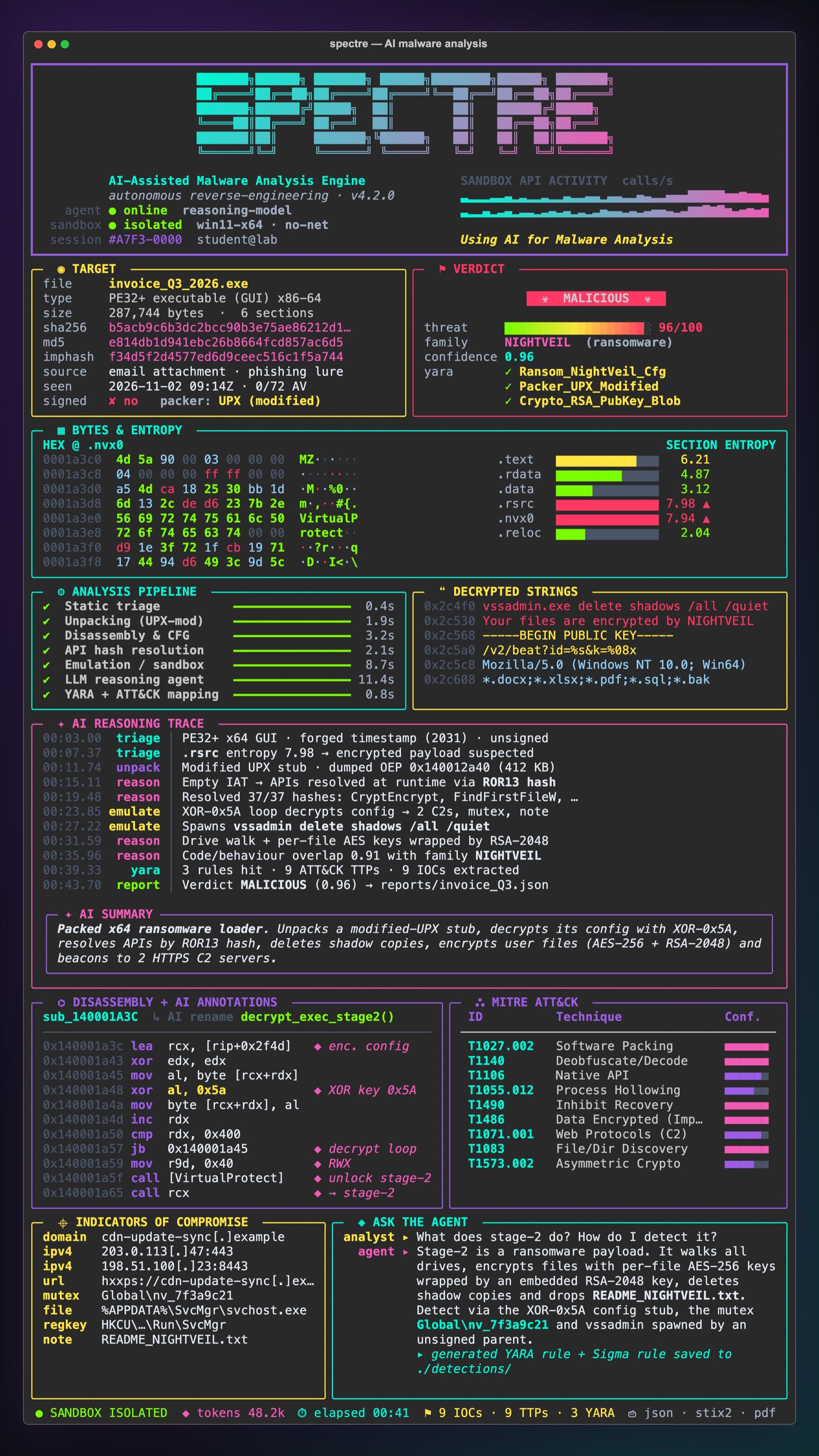
Take next · AI-assisted
Malware Dissection 201
Put large language models to work on real malware. Connect AI to Ghidra, IDA and the debugger, automate triage and build analysis agents whose findings you can verify.
Advanced · 40 hours · 5 days · 5-day bootcamp
View courseGet the full syllabus
Batches start every month from January 2027. Send us an enquiry and we'll email you the detailed brochure and the next batch dates.