
Training · Cyber Defence
Malware Dissection 201
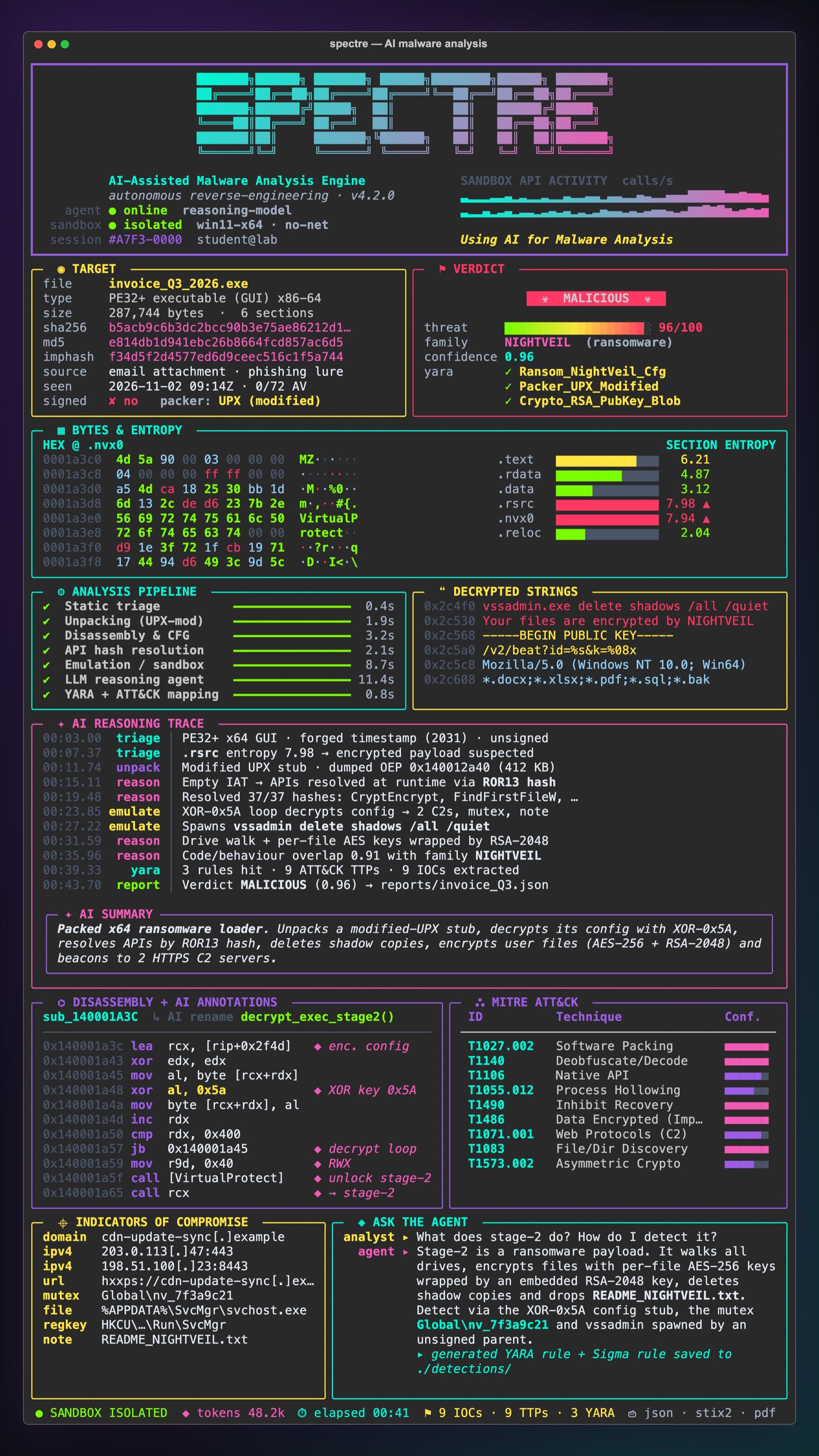
Put large language models to work on real malware. Connect AI to Ghidra, IDA and the debugger, automate triage and build analysis agents whose findings you can verify.
- Advanced
- 40 hours
- 5 days
- 5-day bootcamp
- AI-assisted
About the course
Large language models now read decompiled code, write unpackers and drive reverse engineering tools directly. Used well, they cut hours of routine analysis to minutes. Used carelessly, they produce confident reports full of invented IOCs and wrong verdicts.
This bootcamp teaches analysts to use AI the right way. Every lab runs on locally hosted open-weight models, so samples, prompts and findings never leave the lab, and every AI finding is checked against evidence.
Who should attend
- Malware Dissection 101 graduates
- Malware analysts and reverse engineers
- DFIR and threat intelligence teams facing rising sample volumes
- Detection engineers
- Developers building security automation
What the course covers
Six topics in focus
01
LLMs for reverse engineering
What models do well, where they fail, and how to check them.
02
AI in the disassembler
Ghidra, IDA and x64dbg driven by LLMs through MCP.
03
Automated triage
Pipelines from static tools and sandbox to an AI summary.
04
Agentic analysis
Agents that run tools, with human checkpoints and isolation.
05
Adversarial AI
Malware that hides prompt injection to fool AI analysts.
06
Detection and verification
AI-written YARA and Sigma, tested and measured.
Tools and technologies
- Ghidra
- IDA
- x64dbg
- CAPE
- capa
- Model Context Protocol
- Ollama
- YARA
Course outline
5 days, one capstone
- Day 1 LLMs for reverse engineering How models read code, where they fail, and how to verify what they say.
- Day 2 AI in the disassembler and debugger Connecting a local model to Ghidra, IDA and x64dbg.
- Day 3 Automated triage pipelines From a batch of samples to families, configurations and AI-written extractors.
- Day 4 Agentic malware analysis Analysis agents with guardrails, and malware aimed at AI analysts.
- Day 5 Detection and verification AI-written detections, measuring AI accuracy, and the capstone.
Capstone
AI-assisted versus manual
Teams take an unknown malware family through their own pipeline and agent, produce IOCs and YARA rules, and compare the results with manual analysis.
Outcomes
You will be able to
- Run local LLMs safely on live samples
- Drive Ghidra and IDA from an LLM through MCP
- Build an automated triage and config-extraction pipeline
- Build an analysis agent with guardrails
- Generate, test and measure AI-written detections
Before you join
Prerequisites
- Malware Dissection 101 or equivalent reverse engineering experience
- Working knowledge of Ghidra or IDA and a debugger
- Comfortable writing Python scripts
- No prior AI or machine-learning experience needed

Get the full syllabus
Batches start every month from January 2027. Send us an enquiry and we'll email you the detailed brochure and the next batch dates.